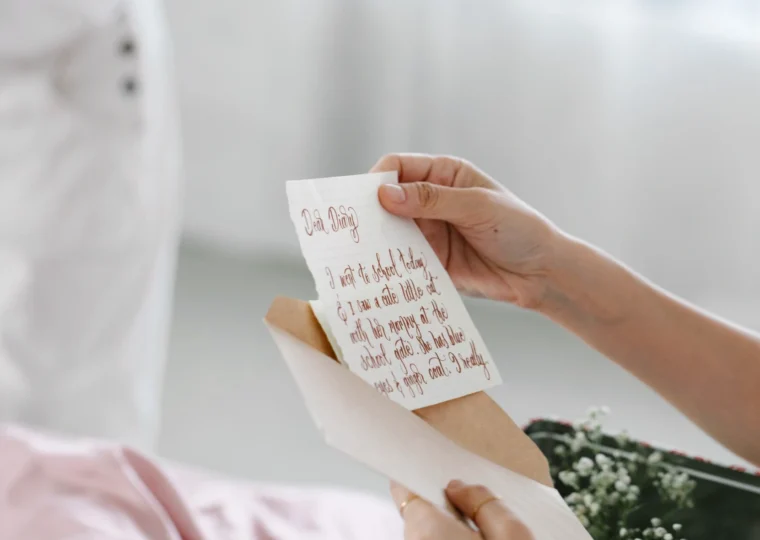

A friendship letter to a best friend should say what makes your bond specific: the moments you remember, the qualities you admire, the support you have felt, and what you hope the friendship carries into the future. If the words are hard to find, use the story-led example below as a starting point, then replace Sophia and Emma’s details with moments only the two of you would recognize.
A Heartfelt Friendship Letter to a Best Friend
Dear Emma,
I still remember the afternoon we missed the last bus after school. It started raining before we had walked two streets, and the umbrella you pulled from your bag was too small for either of us. By the time we reached home, our shoes were soaked, the notes in my bag were wrinkled, and we were laughing so hard that my mother opened the door thinking something wonderful had happened. Nothing extraordinary had happened. I was simply with you, and somehow an inconvenient day became one of my favorite memories.
That is what your friendship has done for my life. You have made ordinary moments feel worth remembering: sharing fries after class, sending voice notes that begin with one story and end twenty minutes later, and sitting beside me when I do not know what to say.
I think most often about the evening before my first big interview. I had convinced myself I would fail, but you arrived with coffee and made me practice every answer until I could hear confidence in my own voice. You did not tell me everything would be perfect. You reminded me that I was prepared and stayed until I believed it too. That kindness has followed me far beyond that one night.
You have also trusted me enough to be honest when I was wrong. We have disagreed, gone quiet, apologized, and learned how to return without pretending nothing happened. Our friendship is strong not because it has been effortless, but because we have chosen honesty over pride and care over being right.
I admire the way you notice people, the way you remember small details, and the way your humor finds light without dismissing what hurts. You have made me braver, calmer, and more willing to believe that I do not have to face every difficult season alone.
Life will change our schedules, cities, and plans. I do not want to make impossible promises about speaking every day or never drifting for a while. I only hope we keep making space for each other – returning to the same table, sharing new stories, and remembering the two girls laughing in the rain.
Thank you for being the friend who feels like family and still lets me be fully myself. I hope I can give you the same steadiness, honesty, and laughter you have given me.
With love,
Sophia
Why a Friendship Letter Can Matter
A letter gives you enough space to be specific instead of settling for “thanks for everything.” In one experiment, people who expressed gratitude to a friend reported greater perceived strength in the relationship than people in comparison groups. More recent experiments also found that gratitude and apologies can shape how responsive a message feels within a friendship. A letter cannot repair every problem, but sincere appreciation and accountable language can open a more honest conversation. See the 2010 gratitude study and the 2024 friendship communication study.
How to Write a Meaningful Letter to Your Best Friend
- Say why you are writing. Start plainly: “I have been thinking about how much your friendship means to me,” or “I did not want another birthday to pass without telling you this.”
- Choose one real memory. A small, recognizable moment often feels more personal than a dramatic statement. Mention the late-night call, the trip that went wrong, the quiet afternoon, or the difficult week they helped you through.
- Name a quality and show it in action. Do not stop at “You are kind.” Explain what their kindness looked like: “You checked on me every morning without expecting a reply.”
- Explain their impact. Tell your friend what changed because of them. Perhaps you became braver, felt less alone, learned to laugh at yourself, or began trusting people again.
- Make the care mutual. Appreciation should not turn your friend into your permanent rescuer. Tell them how you hope to support, listen to, or celebrate them too.
- End with something true about the future. Avoid promises you cannot guarantee. “I hope we keep choosing this friendship through every new season” is often more honest than “Nothing will ever change.”
A Simple Friendship Letter Template
Dear [name],
I have been thinking about [reason or occasion], and it reminded me how grateful I am for you. I still think about [specific memory] because it shows exactly who you are: [quality you admire].
When you [specific action], you helped me [impact]. You have also made the ordinary parts of life better, especially [inside joke, routine, place, or shared interest].
We have been through [milestone or difficult season], and I am proud of how our friendship has grown. I hope we get to [future hope]. Thank you for being someone I can trust, laugh with, and be honest with.
[Natural closing],
[Your name or nickname]
Friendship Letter Examples for Different Situations
Short Friendship Letter to a Best Friend
Dear [name],
I may not say it often, but your friendship is one of the best parts of my life. Thank you for listening, making me laugh, and showing up in ways both big and small. I am grateful for our memories, but even more grateful that we are still making new ones. You mean more to me than a short note can hold.
Love,
[Your name]
Thank-You or Appreciation Letter
Dear [name],
Thank you for the way you have supported me without making me feel like a burden. When [specific situation] happened, you did not try to find perfect words; you simply stayed. That meant more than you probably knew. I admire your [quality], especially the way it showed when you [example]. I hope you feel the same care from me that you have given so freely. I am deeply grateful to call you my best friend.
With appreciation,
[Your name]
Letter to a Childhood Best Friend or a Friend You Have Known for Years
Dear [name],
We have known so many versions of each other: the younger ones who [shared childhood memory], the ones who tried to figure out [school, work, family, or another milestone], and the people we are becoming now. I love that our friendship carries all those chapters without keeping either of us trapped in the past. You know where I came from, respect who I am now, and still make me laugh like no time has passed. You are not just an old friend; you are chosen family.
Always,
[Your name]
Letter to a Long-Distance Best Friend, a Friend Who Moved Away, or Someone You Miss
Dear [name],
I miss the easy access we once had to each other – the unplanned visits, quick meals, and conversations that did not need to be scheduled. Distance has changed the rhythm of our friendship, but not its value. I still carry your advice, your humor, and our memories into ordinary days. I want us to keep finding realistic ways to stay close, even when life is busy. Until we are in the same place again, please know that you are loved, remembered, and never reduced to the miles between us.
Missing you,
[Your name]
Apology Letter to a Best Friend After an Argument
Dear [name],
I am sorry for [specific action or words]. I understand that it left you feeling [impact you can reasonably acknowledge], and I should have handled the situation differently. My intention does not erase the hurt I caused. I value our friendship, but I do not expect you to move past this on my timeline. I am ready to listen, answer honestly, and make this right by [specific repair or change]. If and when you are open to talking, I will be here.
Sincerely,
[Your name]
An effective apology names the action, acknowledges its impact, avoids “if” and “but,” and offers repair. The American Psychological Association’s apology discussion and the Greater Good Science Center’s practical framework provide further guidance.
Letter to a Best Friend Going Through a Difficult Time or Grief
Dear [name],
I know I cannot fix what you are carrying, and I will not ask you to make it sound better than it is. I care about you, and you do not have to face every part of this alone. I can [bring dinner on Tuesday / drive you to the appointment / sit with you / check in next week], and it is completely okay to say yes, no, or not yet. There is no pressure to reply to this letter. I simply want you to know that I see your pain, I love you, and I am here in the ways that are genuinely helpful to you.
With you,
[Your name]
Birthday, Graduation, or Moving-Away Letter
Dear [name],
This moment deserves more than a quick congratulations. I have watched you grow through [specific challenge or milestone], and I am proud of the person you have become. One of my favorite memories from this chapter is [memory], because it captures your [quality] perfectly. As you move into what comes next, I hope you take every lesson, every laugh, and the certainty that someone is cheering for you. Our routines may change, but I want our friendship to keep growing with us.
Proud of you always,
[Your name]
Funny or Lighthearted Friendship Letter
Dear [name],
Congratulations on another year of being the person who knows far too much about me and has somehow chosen not to use it for evil. Thank you for the terrible advice we wisely ignored, the snacks we said we would share, and the jokes that make no sense to anyone else. Beneath all that nonsense is the serious truth: life is much more fun with you in it, and I would choose you as my best friend again – even after [inside joke].
Your favorite bad influence,
[Your name]
Letter to Reconnect After Drifting Apart
Dear [name],
I have thought about you often and wanted to reach out without pretending no time has passed. I am sorry I did not make more effort to stay connected. I still remember [shared memory] with a lot of affection, and I am grateful for the friendship we had. If reconnecting feels right to you, I would love to hear how life has been and start with a simple conversation. There is no pressure or expectation; I just wanted to open the door honestly.
Warmly,
[Your name]
Writing to a Female or Male Best Friend
Write to the person, not to a gender stereotype. A letter to a female best friend does not have to be more emotional, and a letter to a male best friend does not have to hide affection behind jokes. Use “like a sister” or “like a brother” only if that language genuinely fits your bond. Their name, nickname, or a shared phrase will usually feel more personal.
How to Make the Letter Sound Like You
- Replace broad praise with evidence. Instead of “You are always there,” write, “When I called after the interview and could not stop overthinking, you stayed on the phone until I could laugh again.”
- Include ordinary memories. The grocery run, shared playlist, bad movie, missed train, or weekly voice note may feel more intimate than a major event.
- Use your natural vocabulary. If you never say “kindred spirit,” do not put it in the letter. Warmth does not require poetic language.
- Add one future-facing line. Mention a trip, tradition, milestone, or simple routine you hope to share.
- Read it aloud. If a sentence sounds like a greeting card rather than you, simplify it.
Handle Sensitive Friendship Situations Carefully
- After an argument: Keep the apology separate from your defense. Take responsibility before explaining your perspective, and do not use the letter to demand immediate forgiveness.
- When you have drifted apart or the friendship feels one-sided: Avoid guilt, nostalgia as pressure, or claims that the other person owes you closeness. Invite contact and leave them room to choose.
- During grief, illness, or crisis: Do not promise that everything will be fine. Acknowledge what is hard and offer one specific form of help you can actually provide.
- After a friendship breakup or when boundaries have been set: A letter may be better kept private. Sending it should not become a way to bypass blocked contact, safety concerns, or a clear request for space.
- When romantic feelings may be involved: Do not hide a confession inside an appreciation letter. Be honest about your feelings and make it clear that your friend is free to respond without pressure.
The best friendship letter is not the most poetic one; it is the one your friend recognizes as yours. Start with a real memory, name what you appreciate, explain the difference they have made, and end with an honest expression of care.