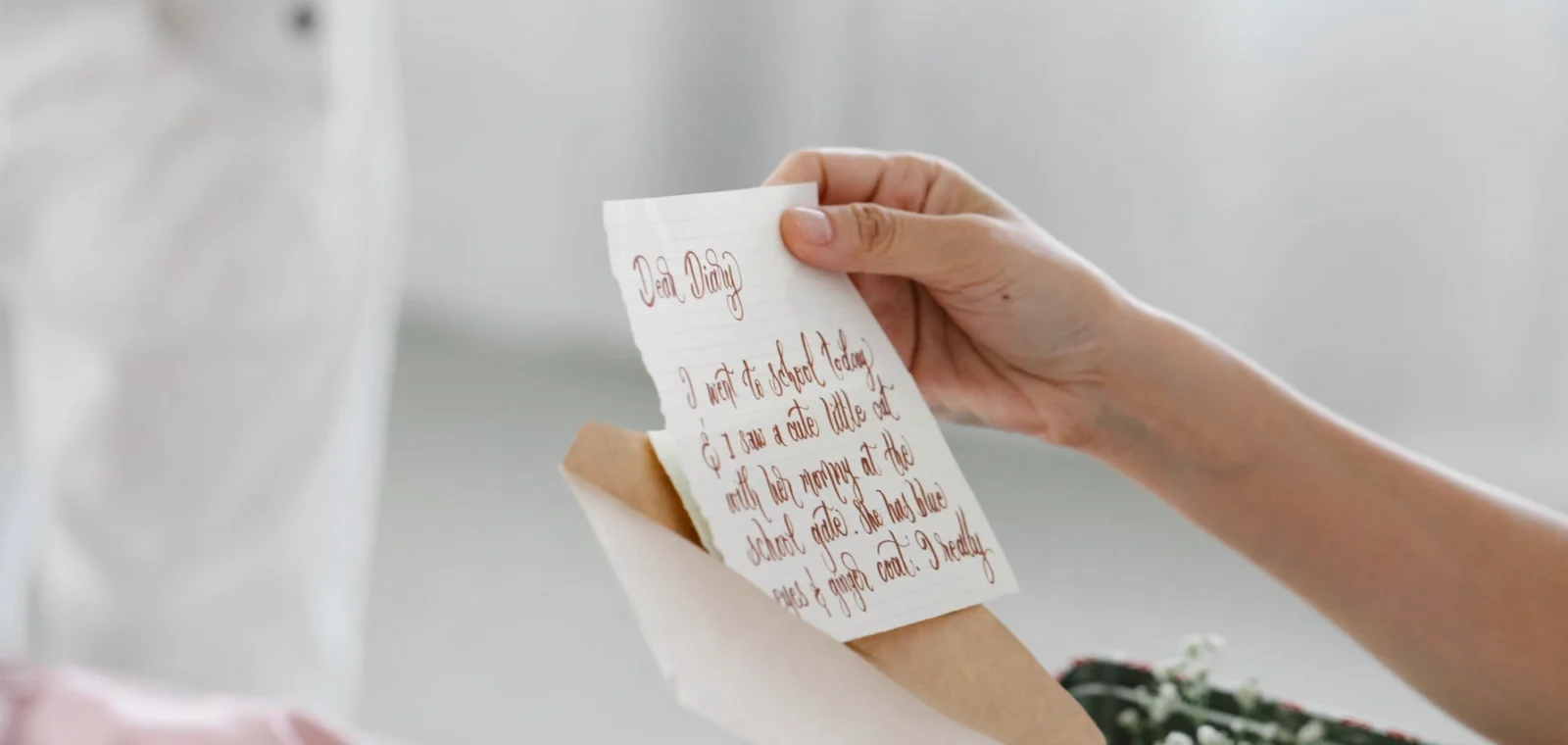
A meaningful letter for Mom does not need to be long or poetic. Start with why you are writing, name one specific memory or thing she did, explain how it affected you, and finish with what you want her to know today. Use the examples below as starting points, then replace their details with your own so the message sounds like you—not like a template.
The simple five-step formula for a heartfelt letter to Mom
- Open naturally with “Dear Mom,” “Mom,” or the name you actually use.
- State your reason for writing in one clear sentence.
- Describe one specific memory, action, habit, or quality.
- Explain its effect: what you felt, learned, or carry with you now.
- Close with love, gratitude, a wish, or an honest next step.
This structure reflects the UC Berkeley Gratitude Letter practice, which recommends describing what the person did, why it matters, and how it affected your life. Purdue OWL personal-letter guidance also emphasizes matching the opening, body, closing, and tone to the audience and purpose.
Choose the kind of letter you want to write
- Heartfelt letter: Tell her what she means to you and connect a memory to the present.
- Thank-you or appreciation letter: Focus on specific care, effort, teaching, or support.
- Birthday letter: Celebrate who she is, not only what she does for other people.
- Mother’s Day letter: Recognize an everyday act, tradition, or quality you value.
- Apology letter: Name the harm, take responsibility, and explain the change you will make.
- Remembrance letter: Write to or about a mother who died, using the language that fits your beliefs.
- Complicated-relationship letter: Be truthful, respect boundaries, and avoid pretending the past was different.
How to make your letter personal instead of generic
Use a scene, not only a compliment
“You were always there for me” becomes more believable when you add the night she waited up, the call she answered, the recipe she taught you, or the words she repeated when you doubted yourself.
Connect the past to who you are now
Explain the lasting effect: “Because you let me make my own decision, I learned to trust my judgment,” or “I now use the same small tradition with my children.”
Write in your normal voice
If you never say “guiding light,” do not put it in the letter. Plain words with real details usually feel warmer than dramatic language borrowed from a quote page.
Use these sentence starters if you feel stuck
- I am writing because I do not say this often enough…
- One memory I keep returning to is…
- I understand now why you…
- You taught me… without ever giving me a formal lesson.
- The quality I admire most in you is…
- When I think of home, I think of…
- I am sorry for…
- What I want you to know today is…
12 original letter-for-Mom examples
1. A heartfelt letter to Mom
Dear Mom,
I do not say this often enough: your love has shaped the way I move through the world. I still think about the evenings you sat with me at the kitchen table and listened until I found the words for what was bothering me. You did not solve every problem for me; you helped me believe I could face it. That quiet confidence became part of my own voice.
I admire your patience, your humor, and the way you make people feel welcome. The older I get, the more I recognize the effort behind the ordinary things I once took for granted.
Thank you for being a steady place in my life. I love you for what you have done, but even more for who you are.
With all my love,
[Your name]
2. A thank-you and appreciation letter for Mom
Dear Mom,
Thank you for the care that rarely announced itself: the rides when you were tired, the meals you remembered I liked, the messages before important days, and the questions you asked when you could tell I was not fine.
I appreciate more than the help itself. You showed me that love can be dependable, practical, and patient. Because of you, I try to notice what people need and to show up before they have to ask twice.
I know gratitude can arrive late, especially for things that once felt ordinary. I see them now. Thank you for the time, attention, and encouragement you have given me, and for the person you continue to be in my life.
Love always,
[Your name]
3. A birthday letter to Mom
Dear Mom,
Happy birthday. Today I want to celebrate you—not only as my mother, but as the curious, funny, determined person you are. I love the way your laugh changes the mood of a room and the way you keep learning, even when something is unfamiliar.
One of my favorite memories is [add a real birthday, trip, meal, or conversation]. It captures what I value about you: [add the quality that memory shows].
I hope this year gives you more time for what restores you, more moments that make you proud, and the freedom to choose joy without feeling that you must first take care of everyone else.
I am grateful I get to know you in every new season of life. Happy birthday, Mom.
With love,
[Your name]
4. A Mother’s Day letter
Dear Mom,
On Mother’s Day, I keep thinking about the small tradition that always made me feel cared for: [add your tradition]. It may have looked ordinary from the outside, but to me it meant safety, attention, and home.
Thank you for the ways you encouraged me to become my own person. I value the advice you gave, but I also value the moments when you stepped back and trusted me to choose. That trust still helps me when I face difficult decisions.
No single day can summarize a relationship or repay years of care. I simply want today to hold one clear message: I notice you, I appreciate you, and I love you.
Happy Mother’s Day.
Love,
[Your name]
5. An apology letter to Mom
Dear Mom,
I am sorry I dismissed your concerns and then stopped responding. That was hurtful, and it left you without an explanation. I was overwhelmed, but that does not excuse the way I handled it.
I understand that my silence may have made you feel ignored or unimportant. I should have told you I needed space and given you a time when I would reconnect.
I want to change the behavior, not just say the right words. From now on, if I need time during a difficult conversation, I will say so clearly and follow through when I promise to call.
I care about our relationship. I also understand that you may need time, and I am not asking you to forgive me before you are ready.
I am truly sorry.
Love,
[Your name]
A sincere apology identifies the action, acknowledges its effect, takes responsibility, and names a repair. Greater Good’s effective-apology guidance and the American Psychological Association’s apology discussion both emphasize that “sorry” is more useful when it is paired with responsibility rather than excuses.
6. A short emotional letter for Mom
Dear Mom,
I may not always find the right words, but I want you to know this: your care has given me strength on days when I had very little of my own. I carry your lessons, your humor, and your love with me. Thank you for being part of who I am.
Love always,
[Your name]
7. A letter to Mom from a daughter
Dear Mom,
As your daughter, I used to think growing up meant becoming completely independent. Now I understand that independence also includes knowing which lessons are worth carrying forward.
You taught me that I could be kind without becoming silent, strong without pretending nothing hurts, and ambitious without apologizing for taking up space. You never required me to become a copy of you. You gave me room to discover myself while reminding me where I came from.
I admire the woman you are, including the parts of your story I only began to understand as an adult. Thank you for trusting me, challenging me, and loving me through the versions of myself that were still learning.
I am proud to be your daughter.
With love,
[Your name]
8. A letter to Mom from a son
Dear Mom,
You taught me a version of strength that I did not always recognize when I was younger. It was in your consistency, your willingness to listen, and the way you kept showing care even when life was demanding.
Thank you for making room for my feelings instead of treating them as something to hide. That has helped me become a better friend, partner, and person. I still hear your advice when I am tempted to react too quickly: pause, understand, and choose what kind of person I want to be.
I am grateful for your faith in me, but I am equally grateful that you held me accountable. Your love helped me grow, not simply feel comfortable.
I love you, Mom.
Your son,
[Your name]
9. A letter in memory of a mother who died
Dear Mom,
I still reach for the phone when something happens that only you would fully understand. Then I remember, and the day feels different.
There is so much I wish I could tell you. I would tell you that I finally made [add a change or milestone], that I still use your [recipe, saying, habit, or tradition], and that your name comes up more often than you might have imagined.
I miss the particular way you [add a sensory or personal detail]. Grief has changed over time, but love has not disappeared with it. I carry you in the choices I make, the stories I repeat, and the care I try to give other people.
Today I am writing because remembering you deserves words.
With love,
[Your name]
You may use spiritual language such as “in heaven” if it reflects your beliefs. You do not need to use it if it does not. Dougy Center includes writing a card or letter among optional ways to remember someone who died; keeping the letter private is also valid.
10. A letter for a stepmom
Dear [Name],
Thank you for the relationship we have built. Joining a family with its own history was not simple, and I appreciate that you gave trust time to grow instead of demanding that it appear immediately.
I especially remember [add a moment when she showed up, listened, helped, or respected a boundary]. That moment told me I could rely on you while still being honest about my own feelings and loyalties.
You have added care, steadiness, and your own traditions to my life. I do not need to erase anyone else to be grateful for you. I value the place you have earned through the way you continue to show up.
With love and appreciation,
[Your name]
11. A letter for an adoptive mom
Dear Mom,
Thank you for the life and relationship we have built together. I am grateful for the ordinary moments that became ours: [add a routine, celebration, difficult conversation, or family joke]. Those details—not a perfect story—are what make our bond real to me.
You have supported me as I have grown into my own identity. I may have questions or feelings about every part of my story, and I appreciate the times you have made room for them without treating them as a rejection of you.
Thank you for loving me as a whole person, listening when the subject was complicated, and continuing to learn with me. I value you, our history, and the relationship we keep choosing.
Love,
[Your name]
12. A letter for a strained or complicated relationship
Dear Mom,
I am writing because our relationship matters to me, and because parts of it have also been painful. I do not want to pretend that everything is fine or reduce our history to only the difficult moments.
I value [name one honest, specific thing you value]. I also need [state a clear boundary or need], especially when [name the situation without insults or diagnosis]. For now, the healthiest way for me to stay in contact is [state the form or frequency of contact you can manage].
I am not asking us to solve everything in one letter. I am asking for a more honest and respectful way forward. If that becomes possible, I am willing to take the next step slowly.
Sincerely,
[Your name]
If the relationship involves abuse, threats, stalking, coercion, or a serious safety concern, you do not owe contact or a letter. Writing an unsent version for yourself may be the safer choice.
Sensitive wording for grief, adoption, stepfamilies, and complicated relationships
Do not assume biology
Avoid treating “she gave birth to me” as the universal reason a mother matters. Use language that fits the actual relationship: raised me, cared for me, chose to show up, taught me, protected me, or made room for me.
Do not rank a “real” mother
In adoption and blended families, “real mom” can erase or wound. Use the terms the people involved prefer, such as adoptive mom, birth mother, first mother, stepmom, bonus mom, or simply Mom. Preferences differ, so follow the relationship rather than a generic rule.
Do not force a perfect story
A meaningful letter can contain gratitude and hurt at the same time. You do not need to call someone your best friend, hero, or greatest supporter if that is not true.
Do not presume religion or an afterlife
Phrases such as “I know you are watching over me” may comfort one reader and alienate another. Use spiritual language only when it genuinely fits the writer’s beliefs.
Do not use an apology to demand reconciliation
An apology is an offer of responsibility, not a request for immediate comfort. Avoid “I’m sorry, but…,” minimizing the harm, explaining the other person’s feelings for them, or asking for forgiveness on a deadline.
Respect privacy
A letter can contain family stories the recipient would not want posted publicly. Ask before publishing, sharing on social media, or reading it in front of other people.
Should you handwrite, email, text, mail, or read it aloud?
- Handwritten letter: Best when the physical keepsake matters and your handwriting is readable.
- Typed or emailed letter: Useful for a longer message, easy editing, distance, or accessibility needs.
- Card: Good for a focused birthday or Mother’s Day message.
- Text message: Appropriate for a short emotional note or a relationship where formality would feel unnatural.
- Read aloud: Potentially powerful in a safe, warm relationship, but ask first if the message is long or emotionally heavy.
- Unsent letter: A valid option for grief, estrangement, private reflection, or any situation where contact would be unsafe.
UC Berkeley’s gratitude-letter practice suggests that delivering and reading a gratitude letter can deepen the experience when it is appropriate. That is an option, not a requirement. Harvard Health notes that gratitude research is generally positive but not universal; a letter should never be presented as guaranteed to heal a relationship or improve mental health.
Frequently Asked Questions
What should I write in a letter for Mom?
Write why you are reaching out, one specific thing she did or one quality you admire, what it meant to you, and what you want her to know now. One honest memory is usually stronger than a page of general compliments.
How do I start a heartfelt letter to Mom?
Start simply: “Dear Mom, I am writing because I do not say this often enough…” You do not need a dramatic opening; clarity and sincerity matter more.
How long should a letter to Mom be?
A short note may be 50 to 100 words, while a fuller letter is often 200 to 500 words. Stop when the central message feels complete. Length does not prove love.
Can I use one of these examples word for word?
You can use the structure, but replace the memories, qualities, and phrases with details from your relationship. Copying every line may sound polished but emotionally anonymous.
What if I am not close to my mother?
Do not manufacture intimacy. You can write a neutral, respectful message, acknowledge one true point of appreciation, state a boundary, or choose not to send anything.
What can I write if my mom has died?
Write what you miss, what you wish you could tell her, a memory you want to preserve, or how her influence continues. You may keep the letter, place it with a photo or memory box, read it privately, or share it with someone you trust.
How do I write an apology letter to Mom?
Name the specific action, acknowledge its impact, take responsibility without “but,” and explain the change or repair you will make. Do not pressure her to forgive you immediately.
Is a handwritten letter better than a text?
Not automatically. A handwritten letter can feel intimate and lasting, but the best format is the one your mother can comfortably receive and that fits your relationship.
What if I have two moms or want to write to a mother figure?
Write separate letters when each relationship deserves its own memories and language, or one shared note when that feels natural to everyone involved. Use the title or name each person prefers.