
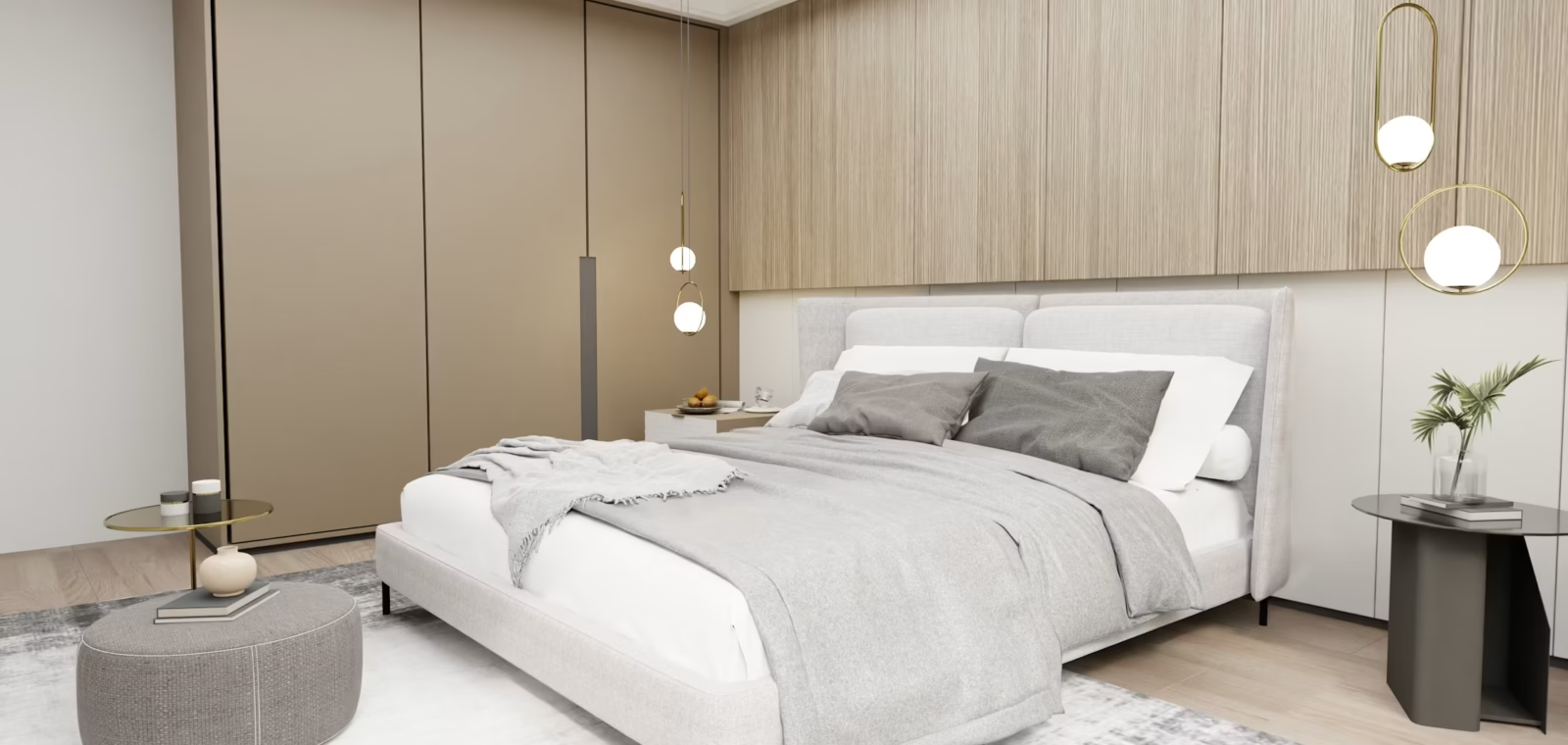
Position a rectangular area rug so its long side usually runs across the width of the bed, then leave enough rug visible for a comfortable landing zone on both sides and at the foot. In most bedrooms, the best default is to place the rug under the lower two-thirds of the bed with the nightstands off the rug; in a larger room, the entire bed and nightstands can sit on a larger rug. Aim for roughly 18–24 inches of visible rug where space allows, but treat that as a design target rather than an inflexible rule.
Quick Answer: The Best Rug Position Under a Bed
- Best all-around layout: place the rug under the lower two-thirds of the bed so the bed feels anchored while the nightstands stay on the floor.
- Best full-coverage layout: use a larger rug under the entire bed; if nightstands also sit on it, keep all four legs of each nightstand on the same surface.
- Best small-room layout: place the rug under the lower half of the bed, or use secure runners beside the bed.
- Best visible-rug target: about 18–24 inches beyond the sides and foot is a common designer range; 12–18 inches can still work in a tighter queen-bedroom layout.
- Best safety practice: keep edges flat, use a floor-compatible non-slip rug pad, and avoid positioning furniture so some legs sit on a thick rug while others sit on bare floor.
How Far Should a Rug Extend Past the Bed?
For a balanced bedroom rug placement, plan for approximately 18–24 inches of rug beyond the exposed sides and foot of the bed when the room can accommodate it. Castlery and Rugs Direct both use this range, while Crate & Barrel gives a somewhat tighter 12–18-inch recommendation for queen beds. That difference matters: rug placement is a proportion decision, not a building-code measurement.
A better rule is to start with the bed and room dimensions, then test the landing area. The rug should be visible enough to visually anchor the bed and wide enough that your feet do not immediately land on bare flooring when you get up. In a compact room, a smaller but symmetrical border can look better than forcing a large rug too close to the walls, door swing, dresser, or closet path.
Around the room perimeter, leaving some exposed flooring usually creates a cleaner frame. Guidance varies from about 6–12 inches in tighter rooms to 8–18 inches in larger rooms. Consistency is more important than chasing one exact number.
Best Rug Size Under Each Bed Size
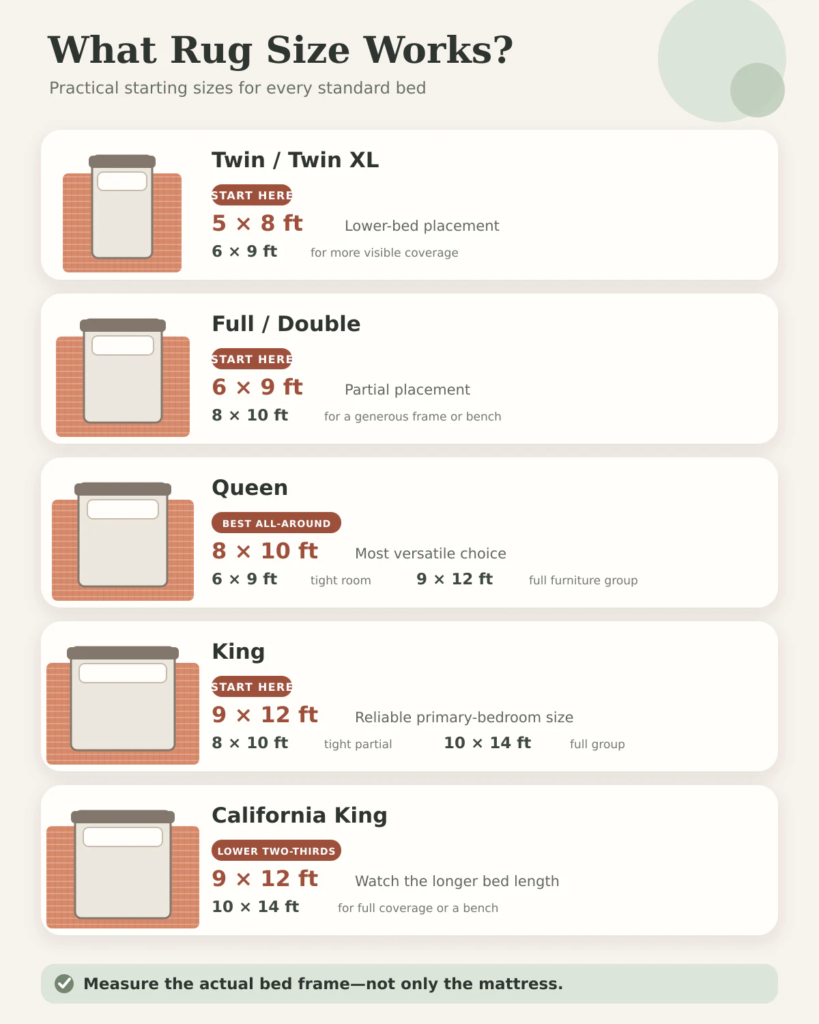
Use the actual outside dimensions of the bed frame—not only the mattress label—before buying. Standard U.S. mattresses are approximately 38 × 75 inches for twin, 38 × 80 for twin XL, 54 × 75 for full, 60 × 80 for queen, 76 × 80 for king, and 72 × 84 for California king. Upholstered rails, platform frames, footboards, and oversized headboards can add several inches to the real footprint.
Twin or Twin XL Bed
A 5 × 8-foot rug is a practical starting point for a single twin bed when the rug is positioned under the lower portion of the bed. A 6 × 9-foot rug gives more visible floor coverage and works better in a larger guest or child’s room. If the bed is pushed against a wall, one runner or a smaller bedside rug may be more useful than forcing a large centered rug.
Full or Double Bed
A 6 × 9-foot rug commonly works for a full bed with partial under-bed placement. An 8 × 10-foot rug gives a more generous frame and can better support a bench at the foot or a larger room. Avoid choosing by bed size alone; a bulky frame can make the same rug look noticeably smaller.
Queen Bed
For most queen beds, an 8 × 10-foot rug is the most versatile general-purpose choice because it gives enough width to frame a 60-inch mattress and enough depth for flexible positioning. A 6 × 9 can work in a smaller bedroom with a lower-two-thirds layout, while a 9 × 12 is better when you want the bed and nightstands to feel like one anchored furniture group. Bassett’s queen-bed guide discusses sizes from 5 × 7 through 9 × 12, but the smaller options require more compromise in visible rug coverage and placement.
King Bed
A 9 × 12-foot rug is the most reliable starting point for a king bed in a typical primary bedroom. An 8 × 10 can work for a tighter partial placement because the 10-foot dimension can run across the bed, but it leaves less flexibility at the foot and around nearby furniture. For a large room or full bed-plus-nightstands layout, a 10 × 14-foot rug often creates better proportion.
California King Bed
Because a California king is longer than a standard king, pay extra attention to the rug dimension running from head to foot. A 9 × 12-foot rug can work for lower-two-thirds placement, while a 10 × 14-foot rug gives more room for full coverage or a bench at the foot. Measure the frame and the remaining walkway before committing.
5 Correct Ways to Position a Rug Under a Bed
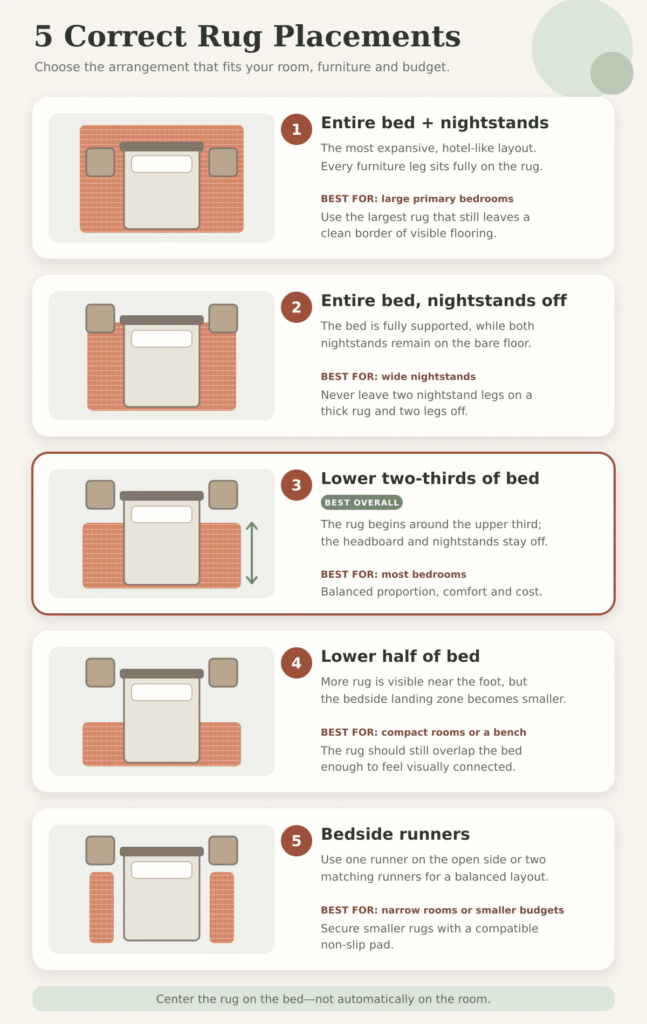
1. Entire Bed and Nightstands on the Rug
This is the most expansive, hotel-like arrangement. The rug extends high enough toward the headboard that the entire bed and both nightstands sit on it. It works best in a large primary bedroom and requires the largest rug of the main placement options.
- Best for: large bedrooms, wide furniture groupings, and a unified luxury look.
- Watch for: rug edges crowding walls, doors, dressers, or closet openings.
- Stability rule: all legs of each nightstand should sit on the rug rather than straddling a thick rug edge.
2. Entire Bed on the Rug, Nightstands Off
Here the bed is fully supported by the rug, but the nightstands remain on the surrounding floor. This gives more coverage under the bed without requiring the rug to extend far enough sideways to include bedside furniture. It is useful when the nightstands are wide or when you want a visible floor break around them.
Keep the rug centered on the bed, and make the left and right exposure look intentional. If the rug is thick, do not leave a nightstand with two legs on the rug and two on the floor; that can make the furniture sit unevenly.
3. Rug Under the Lower Two-Thirds of the Bed
For most bedrooms, this is the best combination of proportion, comfort, and cost. “Lower two-thirds” means roughly two-thirds of the bed’s length rests over the rug, so the rug begins around the upper third of the bed—not that the rug begins two-thirds of the way down from the headboard. That distinction is often explained poorly online.
In this layout, the headboard and nightstands usually remain off the rug. The rug should still extend evenly past both sides and enough beyond the foot to look deliberate. Bassett also identifies lower-two-thirds placement as a common bedroom arrangement.
4. Rug Under the Lower Half of the Bed
A lower-half placement uses less rug under the bed and pushes more of the rug toward the foot. It can work in a compact bedroom, with a decorative bench, or when you want to show more hardwood near the headboard. The tradeoff is that you may lose the soft landing zone beside the upper half of the bed, so test where your feet actually touch the floor.
This is different from simply placing an accent rug in front of the bed. A lower-half rug still overlaps the bed enough to visually connect to it; a rug floating entirely beyond the foot reads as a separate accent zone.
5. Runners or Smaller Rugs Beside the Bed
If a full area rug does not fit the room or budget, use one long runner on the open side of a wall-mounted bed, two matching runners on both sides, or small rugs where your feet land. This works particularly well in narrow rooms and can be easier to clean or replace.
Small rugs need more attention to slip resistance because less furniture weight holds them in place. In homes where an older adult or someone with reduced mobility uses the bedroom, a secured low-profile runner is generally a safer choice than a loose small throw rug.
How to Measure for a Rug Under a Bed
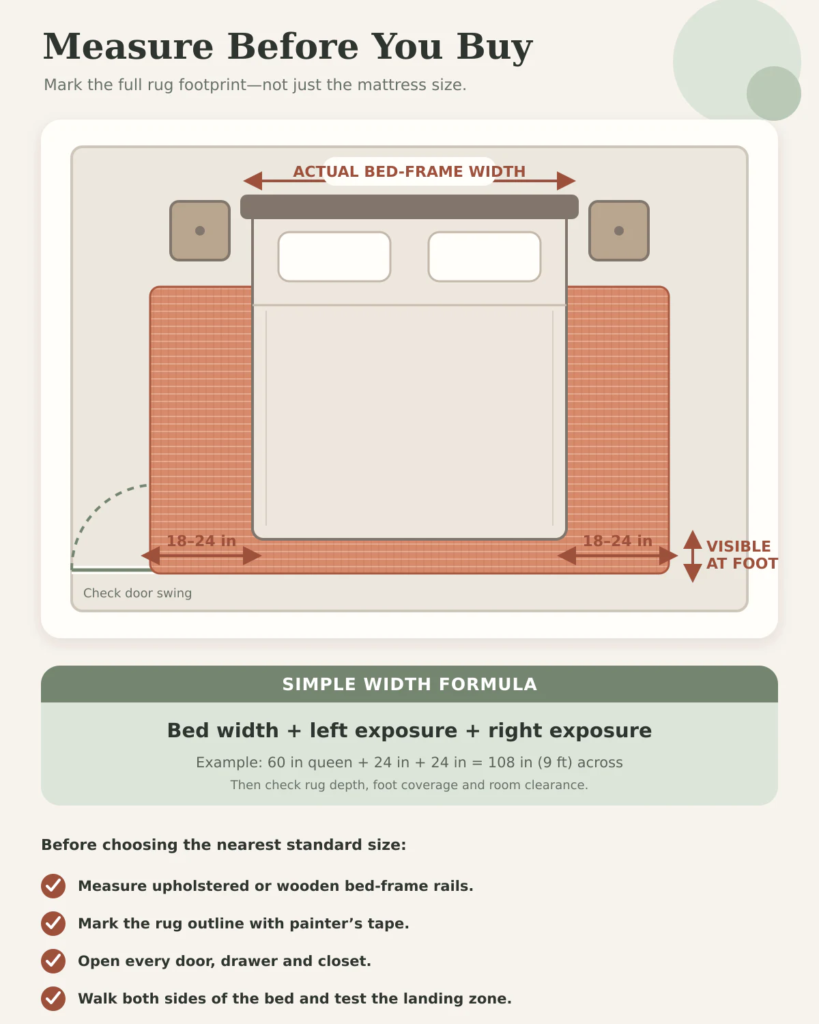
Do not start with the rug size. Start with the footprint you want the rug to cover.
- Measure the actual outside width and length of the bed frame, including upholstered or wooden rails.
- Measure the room and mark doors, closets, radiators, floor vents, dressers, benches, and the main walking path.
- Choose the placement method: full bed and nightstands, full bed only, lower two-thirds, lower half, or runners.
- Decide how much rug you want visible on each exposed side—18–24 inches is a strong target when the room allows it.
- Use painter’s tape to mark the proposed rug outline on the floor. Walk around the bed, open every door and drawer, and sit on any bench.
- Only then choose the nearest standard rug size. If two sizes fit, the larger option usually looks more intentional, provided it does not crowd circulation.
Simple Sizing Formula
For the dimension running across the bed: bed-frame width + desired left-side exposure + desired right-side exposure = minimum rug dimension across the bed.
Example: a 60-inch queen mattress with 24 inches of visible rug on each side needs at least 108 inches, or 9 feet, across the bed. A standard 6 × 9 rug can technically meet that width when its 9-foot side runs across the bed, but its shorter 6-foot depth limits how much rug can sit under the bed and extend past the foot. This is why an 8 × 10 often feels more forgiving even though the side-to-side math alone suggests a smaller rug can work.
Should Nightstands, Benches, and Dressers Sit on the Rug?
- Nightstands: either keep them fully off the rug or fully on it when possible. Half-on/half-off positioning is less stable on thick rugs and often looks accidental.
- Bench or ottoman: if it sits at the foot of the bed, leave enough rug beyond the bed for the bench to sit fully on the rug and for feet to land comfortably in front of it.
- Dresser: it does not need to share the bed rug. In most rooms, the rug can stop before the dresser as long as the walking path remains comfortable.
- Accent chair or reading nook: in a large bedroom, treat it as a separate furniture zone rather than stretching the bed rug unnaturally to catch every piece of furniture.
Room Proportion Matters as Much as Bed Size
The same 8 × 10 rug can look generous in one bedroom and undersized in another. Before choosing a rug, look at the relationship among the bed, exposed flooring, wall boundaries, and circulation paths.
- Small room: prioritize a clear walkway and door/closet clearance. A 6–12-inch floor border can be acceptable if it looks even.
- Medium room: a lower-two-thirds arrangement usually creates the easiest balance between rug, bed, and visible floor.
- Large primary bedroom: a larger rug can unify the bed, nightstands, and bench, while a separate rug may define a reading or seating area.
- Bed against a wall: symmetry around the bed is less important than giving the open side a comfortable landing surface.
- Off-center architectural layout: center the rug on the bed first, not automatically on the room, unless another major focal point requires a different composition.
Safety, Accessibility, and Floor Protection
A bedroom rug is not only decorative. Poorly secured rugs can shift, curl, catch a foot, interfere with a door, or make furniture sit unevenly. These issues matter more in a dark bedroom at night and in homes with children, older adults, or anyone using a cane, walker, or wheelchair.
- Use a non-slip rug pad that is compatible with both the rug and the flooring. The pad should sit slightly inside the rug edge so it does not create a raised lip.
- Keep rug edges flat. Replace or correct curled corners, ripples, and bunching rather than relying on furniture weight alone.
- Check door clearance before buying a high-pile or heavily padded rug.
- Keep bed and nightstand legs on the same level whenever possible. Thick rug edges under only some legs can create wobble.
- For mobility-sensitive rooms, favor a secure, lower-profile rug and keep main walking paths clear.
- Check the flooring manufacturer’s care instructions before using rubber-, latex-, or adhesive-backed pads. Some flooring products have specific restrictions that can affect finishes or warranties.
For bedroom safety, keep rugs flat, secure, and clear of main walking paths. See the U.S. Consumer Product Safety Commission and National Institute on Aging for additional fall-prevention guidance.
Rug Placement on Hardwood, Tile, Laminate, or Carpet
Hardwood, Tile, or Laminate
A non-slip pad can reduce rug movement and help protect the floor from abrasive backing. Choose the pad based on the floor manufacturer’s compatibility guidance rather than assuming every rubber or latex pad is safe for every finish. Periodically lift the rug to clean underneath and check for trapped grit, moisture, or discoloration.
Wall-to-Wall Carpet
You can place an area rug under a bed on carpet to add color, texture, or definition. Use a pad designed for rug-on-carpet applications if the rug tends to creep or ripple, and avoid an unnecessarily thick stack that makes furniture unstable. A low- to medium-pile area rug is often easier to keep flat over carpet than a very plush rug. For broader technical guidance on carpet and rugs, the Carpet and Rug Institute publishes research and resources for consumers and professionals.
Common Rug-Under-Bed Mistakes
- Buying by mattress size without measuring the actual bed frame.
- Using the same rug size for every room simply because the bed size is the same.
- Confusing “lower two-thirds on the rug” with starting the rug two-thirds of the way down the bed.
- Choosing a rug that disappears almost entirely under the bed.
- Leaving nightstand legs split between a thick rug and bare floor.
- Pushing a large rug so close to walls that it looks like badly fitted carpet.
- Ignoring the door swing, closet doors, drawers, vents, or a bench at the foot.
- Using loose bedside rugs without a suitable non-slip solution.
- Dragging a heavy bed across hardwood or the rug instead of lifting safely or using appropriate furniture-moving aids.
Frequently Asked Questions
Which way should a rug go under a bed?
Usually, place a rectangular rug perpendicular to the bed’s length so the rug’s longer dimension runs across the width of the bed. This creates more usable rug on both sides. A different orientation can work in an unusually shaped room, but the bed should still look centered and intentionally anchored.
How much of the rug should be under the bed?
For most bedrooms, place roughly the lower two-thirds of the bed over the rug. Full-under-bed placement is better in a large room; lower-half placement can work in a small room or with a bench at the foot.
How far should a rug extend beyond a bed?
About 18–24 inches beyond the exposed sides and foot is a strong target when space allows. In tighter rooms, a smaller but even border can still work. The rug should not obstruct doors or crowd the walls simply to hit a rule-of-thumb number.
Should the rug go under the nightstands?
It can, but it does not have to. For a large, cohesive layout, place both nightstands fully on the rug. For the common lower-two-thirds layout, leave both nightstands fully off the rug. Avoid unstable half-on/half-off placement on a thick rug.
Is an 8 × 10 rug good under a queen bed?
Yes. An 8 × 10 rug is one of the most flexible sizes for a queen bed and works especially well for lower-two-thirds placement. A 9 × 12 is better when the room is large or you want to include nightstands, while a 6 × 9 can work in a smaller room with more limited coverage.
Can an 8 × 10 rug work under a king bed?
Yes, but mainly as a tighter partial placement with the 10-foot dimension running across the bed. A 9 × 12 rug usually gives a king bed better visual balance and more flexible coverage at the foot.
Can you put a rug under a bed on carpet?
Yes. Layering an area rug over carpet can define the bed zone and add texture. Use a rug-on-carpet pad if needed to reduce shifting or rippling, and make sure the combined thickness does not make the bed or bedside furniture unstable.
Do you need a rug pad if the bed holds the rug down?
A bed may keep the center from moving, but exposed rug edges can still shift or curl. A suitable rug pad can improve grip, cushioning, floor protection, and edge stability. Choose one that is approved for your floor type.
How close should a bedroom rug be to the wall?
There is no universal measurement. A visible floor border of roughly 6–18 inches is common depending on room size. More important than the exact number is keeping the border intentional, reasonably consistent, and clear of doors and circulation paths.